Showing posts with label book review. Show all posts
Showing posts with label book review. Show all posts
Sunday, July 10, 2011
Ready Player One by Ernest Cline
Ready Player One by Ernest Cline
This is a dystopian novel set in the year 2044. You could also call it a quest novel, a coming of age novel, or near future science fiction. It melds many different themes into a unique, funny, and exciting story. The one common theme that seems to unite all of it is geek culture, video games, and the 1980s.
Wade Watts the main character, is a geeky kid who spends most of his time in the virtual world of OASIS. Virtual reality in this setting is extremely realistic. Wade Watts even goes to school in the virtual world. The virtual world he escapes into is infinitely better than his horrific, crowded, dangerous trailer park existence in the real world. The theme of bits versus atoms pervades this book. In the real world, even virtual money is worth more than most national currencies.
The story is centered around a contest to gain control of the world wide virtual world called OASIS. To do this, the entrants must solves riddles that were part of the creator of the virtual world's childhood. The childhood is a kind of super fanboy and geek festival filled with 1980s references; everything from Duran Duran to Star Trek to the video game Joust. It is very funny. It reminds me a bit of my own childhood.
The book adds in many tropes: a love interest, an evil corporation, and plenty of action. It moves very quickly from scene to scene and makes you want to find out what happens next. The book made me laugh and smile while I was reading it. It is lot of fun especially if you are nostalgic about the 1980s, liked roleplaying games, video games, comics, and listened to rock music.
Ernest Cline has a website http://www.ernestcline.com/ . The book Ready Player One is coming out in August of 2011. I was reading an advanced reading copy sent to me by Library Journal I think this book will cross reading genres and be appealing to a wide audience.

Saturday, May 29, 2010
Daily Thoughts 5/29/2010
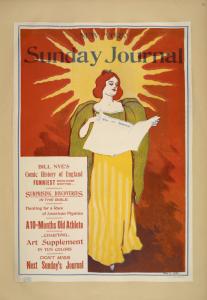
New York Sunday Journal, May 3, 1896. Why did I post this on Saturday, to protest the idea of having to collect all my thoughts on Sunday and post them all at once as a Salon post.
Daily Thoughts 5/29/2010
Anyways, the big book convention is over. I had a chance to go through and look at the blog list of the Book Bloggers Convention. I never did put up a button for them. These are a few of the blogs which I liked from the list. I visited all of them to see what they looked like. Sometimes, it is a chance to just see what people are doing. http://bookbloggerconvention.com/attendees I probably should have gone through this before I went to the reception. But, then I am not very good at should have.
I really like the Rasco from RIF (Reading Is Fundamental) blog. It has a very clear design and excellent message. http://www.rascofromrif.org/ Reading Is Fundamental is part of the Summer Reading programs at most public libraries in the United States. I also liked Jeff's, The Reading Ape Blog http://thereadingape.blogspot.com/. His summary of Book Expo America is quite good. I joined the Book Bloggers Hop on Crazy For Books, I am #175, http://www.crazy-for-books.com/. I sometimes twitter with Marie from The Boston Bibliophile which is a quite nice blog. She is also a librarian blogger. http://www.bostonbibliophile.com/ . Maw Books by Natasha is of course wonderful, she was the primary arranger of the Book Blogger Convention. http://blog.mawbooks.com/ . There is also The Book Publicity Blog which I find fascinating.http://yodiwan.wordpress.com/. I have never seen so many book publicists in one place...
I also looked through the industry bloggers. The AMACom Blog looks quite interesting, it is often hard to find decent reviews for business books. I think I will get Investing In A Sustainable World Why Green Is The New Color of Money On Wall Street by Matthew J. Kiernan, Ph.D. http://amacombooks.wordpress.com/ . Another industry blog which looks very nice is Online Publicist. http://onlinepublicist.blogspot.com/. I liked the design of Authors on the Web, they left us a gift in the goody bag yesterday, a reading light. http://authorsontheweb.com/. I was surprised to have missed Quirk Books, http://irreference.com/ They are famous for Seth Grahame-Smith, Pride and Prejudice and Zombies. We also purchased Queen Victoria Demon Hunter from them as well as Abraham Lincoln Vampire Hunter for our library. Pride and Prejudice and Zombies was recently turned into a graphic novel.
Some Final Thoughts on Book Expo and the Book Blogging Convention.
One of the underlying conversations at the Book Expo was about reviewing. Although, it was not said out loud, the publishers were giving out a lot less review copies to attendees. Some were also limiting their copies to "reviewers." They were also trying to switch away from physical copies to either codes which allowed downloads to books or egalleys. This was a way to lower costs and improve distribution. While I was following the Ning Book Blog group there were questions about how international readers could get galleys. I would imagine that shipping a physical galley overseas via airmail would be cost prohibitive.
During Ron Hogan's talk he said that blogs had won out against review sites. He told us that places like the Los Angeles Times, The New York Times, The Wall Street Journal and others were creating their own blogs to review books. The specific blog that Ron Hogan mentioned was Jacket Copy of the Los Angeles Times. Ron Hogan made a statement that Bloggers have won. I read the Books section of the New York Times on occassion looking at Paper Cuts one of the New York Times blogs.
I am not 100% sure about this, but I can tell you that blogs do have some advantages. They do not have to follow a formula or editorial policies created in review periodicals. They can innovate in their style. I often find myself when reading library review material wondering if they copied the dust jacket copy practically word for word to create the review. I think this is one of the reasons that Kirkus Reviews survived; they were willing to include more negative reviews and more florid language.
Bloggers can put an original voice and style into reviews. They can also add new conventions to describing books like adding descriptions of layout, style, and photography in books. There are no rules right now. Also, with nonstandard language it is much easier to prove you have read a book. A blogger can use much more original language. Hopefully, reviewers at the professional journals will adapt some of the better conventions from blogs as they are tried.
While I was at the Book Bloggers Convention, there was another group conversation about bloggers and reviewers. Bloggers do not have to write negative reviews. If someone gives you a book and you write a negative review, you might not get another free galley from them. It is often difficult to write a negative review. A blogger is not getting paid to write a review. Often, they are reading for pleasure. There is no requirement for them to finish reading a book which they do not like. A reviewer is being paid. The blogger can simply stop reading. I still think it is best to have at least a mention that they stopped reading a book and why.
There is an unacknowledged tension between the style of "readers advisory" and "literary criticism." The style of literary criticism appears to be fading a bit for popular titles. During the Librarians 2nd Annual Shout and Share, which is a book talking panel by collection development librarians, at around 3:45 p.m. Miriam Tuliao cofounder of Earlyword.com http://www.earlyword.com/ mentioned a new trifecta for bestsellers. If a book is prominently featured in USA Today, People, and Entertainment Weekly it will most likely appear on the bestseller lists. I hope, I will not have to read these magazines to measure some of the popular titles to get.
This is a bit stunning. I like many of the print publications like the New York Review of Books which is on Facebook http://www.facebook.com/NYRB.Classics and hope they are quick and adaptable in meeting the challenges facing them. My hope is that purely popular institutions will not have too much impact on our reading habits.
The final question which I faced directly, is "Is a blogger a reviewer?" Many people both write literary reviews and blogs. How do you approach a company and ask them for books who want their books reviewed, but are a little shy of giving a blogger a book. Luckily, because I work around a constant flow of books, I don't have to hunt for new books to read and review. Others do. I still really want certain titles on occassion. At the Book Blogger Convention, we were given contact sheets for Harper Collins to request review copies if we wanted them for blogs.
Sunday, April 25, 2010
Chuck Klosterman Eating The Dinosaur
Chuck Klosterman Eating The Dinosaur
Chuck Klosterman writes novels and journalism. This book is a collection of essays focused on popular culture. It has a slight edge to it, a kind of independent feeling you might associate with independent rock or independent bookstores. I had heard comparisons between Chuck Klosterman and Hunter S. Thompson, but it really does not feel that way. There is no sense of outlaw violence or danger in reading Chuck Klosterman's writing.
The essays are very self reflective and can seem a little overwrought at times. Even so, I can identify with what the author is writing about. The topics he is writing about, alternative rock, sports, film making, and popular culture seem to be aimed at men in the age range of twenty to forty. There is a bit of humor thrown in. I especially liked his chapters on why he hates television laugh tracks and why time travel movies got it all wrong.
To understand some sections, of his writing you have to be familiar with pop culture. He makes statements like Details magazine was the best interview magazine from the 1980s. This can be silly sometimes. He also refers to major rock bands like Curt Cobain and Cheryl Crow. I can almost picture his ideal reader as being a thirty year old man who listens to Garth Brooks, watches the Super Bowl, and likes to watch PBS documentaries.
He is especially good at picking out interesting and eccentric figures in popular culture. I liked reading about Errol Morris, the most prominent American documentary film maker. If you look in the index it looks like he picked names out of popular culture dictionary running from Paula Abdul to Tom Wolfe.
This was a relaxing read; a way to spend an afternoon letting your mind wander.
Saturday, December 5, 2009
Trust Agents Using The Web To Build Influence , Improve Reputation, and Build Trust by Chris Brogan
Trust Agents Using The Web To Build Influence , Improve Reputation, and Build Trust by Chris Brogan and Julien Smith
Chris Brogan is a master communicator using the web. He runs one of the top marketing blogs at http://www.chrisbrogan.com . His main focus is showing people how to build a following in social media using openness and trust. He is also the founder of Podcamp which is a conference on podcasting. Julien Smith is a web analyst.
The ideas in this book are actionable. Every chapter gives suggestion on how to improve your use of social media. I have already used two of the suggestions; make sure you follow less people than are following you on twitter and try to make all the sections about yourself on blogs consistent and professional.
His aim is to teach you how to use social media like blogs, twitter, facebook, and linked in to create a network. This is supposed to help you eliminate the need for resumes and cut back on using business cards.
In addition to the social media tools Chris Brogan and Julien Smith suggest philosophical and strategic outlooks for looking at business. These include looking at work as a game, jumping the gates to create new opportunities, life hacking, leverage, and digital nativism. These strategies are the strategies of the most successful producers of web content and marketing.
There is a message that marketing and communications are becoming more personal. Customer service is described as being public relations. Marketing is about being open and listening to people. Networking is about helping others achieve their goals by pulling them up.
The book is a tool to change your perspective and improve your ability to network on the web. It is the mindset of the native producer of digital content. The ideas are different and interesting. There is a lot that can be used directly from this book to succeed in building your own extensive network of contacts.
Chris Brogan is a master communicator using the web. He runs one of the top marketing blogs at http://www.chrisbrogan.com . His main focus is showing people how to build a following in social media using openness and trust. He is also the founder of Podcamp which is a conference on podcasting. Julien Smith is a web analyst.
The ideas in this book are actionable. Every chapter gives suggestion on how to improve your use of social media. I have already used two of the suggestions; make sure you follow less people than are following you on twitter and try to make all the sections about yourself on blogs consistent and professional.
His aim is to teach you how to use social media like blogs, twitter, facebook, and linked in to create a network. This is supposed to help you eliminate the need for resumes and cut back on using business cards.
In addition to the social media tools Chris Brogan and Julien Smith suggest philosophical and strategic outlooks for looking at business. These include looking at work as a game, jumping the gates to create new opportunities, life hacking, leverage, and digital nativism. These strategies are the strategies of the most successful producers of web content and marketing.
There is a message that marketing and communications are becoming more personal. Customer service is described as being public relations. Marketing is about being open and listening to people. Networking is about helping others achieve their goals by pulling them up.
The book is a tool to change your perspective and improve your ability to network on the web. It is the mindset of the native producer of digital content. The ideas are different and interesting. There is a lot that can be used directly from this book to succeed in building your own extensive network of contacts.
Sunday, July 26, 2009
Wildfire A Novel by Sarah Micklem
Wildfire A Novel by Sarah Micklem
This novel is about a woman in a fantasy setting named Firethorn. It is the second book in a trilogy. I liked the first book, Firethorn. I rather like that the main character survives by her wits. She is the concubine of a knight who follows him to war. There is magic in this novel, but not the magic of blessed swords and wizards throwing lightning bolts. Firethorn is a healer and is sometimes touched by visions and dreams. She also comes from a conquered people.
The novel is very visceral. There is a lot of violence and sex (often artfully described, maybe with a hint of the Kama Sutra) . Also because the main character is a healer, we get descriptions of diseased people being cured with herbs, or women giving birth. The descriptions in the writing seem to draw from history. I can recognize ideas or images from the myths and history of India, Japan, the Celts, and the Germanic peoples.
The novel is full of surprises. At one point the main character is a bonds woman in a foreign land and eventually rises to become a courtesan. It does not end in the way I expected at all.
This novel is quite literary. It feels like it was very well researched. The descriptions are often very intense; being bitten by poisonous snakes, collecting herbs by the river beds, praying to Ardor Hearthfire, divining with finger bones.
Wildfire is 519 pages long making it an epic tome. It was hard to put down at points. It is not a typical novel at all. I like the cover art for the novel. I also liked the poetry and the few drinking songs in the novel. The authors background in graphic design shows in how well the novel is paced and laid out. Publishers Weekly gave this book a starred review.
This novel is about a woman in a fantasy setting named Firethorn. It is the second book in a trilogy. I liked the first book, Firethorn. I rather like that the main character survives by her wits. She is the concubine of a knight who follows him to war. There is magic in this novel, but not the magic of blessed swords and wizards throwing lightning bolts. Firethorn is a healer and is sometimes touched by visions and dreams. She also comes from a conquered people.
The novel is very visceral. There is a lot of violence and sex (often artfully described, maybe with a hint of the Kama Sutra) . Also because the main character is a healer, we get descriptions of diseased people being cured with herbs, or women giving birth. The descriptions in the writing seem to draw from history. I can recognize ideas or images from the myths and history of India, Japan, the Celts, and the Germanic peoples.
The novel is full of surprises. At one point the main character is a bonds woman in a foreign land and eventually rises to become a courtesan. It does not end in the way I expected at all.
This novel is quite literary. It feels like it was very well researched. The descriptions are often very intense; being bitten by poisonous snakes, collecting herbs by the river beds, praying to Ardor Hearthfire, divining with finger bones.
Wildfire is 519 pages long making it an epic tome. It was hard to put down at points. It is not a typical novel at all. I like the cover art for the novel. I also liked the poetry and the few drinking songs in the novel. The authors background in graphic design shows in how well the novel is paced and laid out. Publishers Weekly gave this book a starred review.
Sunday, May 3, 2009
Good To Great By Jim Collins
Good To Great Why Some Companies Make the Leap... and Others Don't By Jim Collins
This book is about how companies go from being good companies to companies that create long term sustained great performance. The book identifies eleven publicly traded companies from the Fortune 500 that went from barely beating the market to having continuous returns of at least twice the market for stockholders. I am not sure how this applies to libraries, but the book attempts to define a set of principles on making a company great.
The message in this book was easy to identify with. There are no complex strategies, flashy leadership secrets, or special financial techniques. This book is about how to inspire discipline, find a consistent simple purpose, create continuous incremental change, choose the right technologies, and bring very focused leadership on board.
One of the first things that Jim Collins writes is that it is impossible to implement any sustainable strategy without first bringing the right people on board. He also writes that it is as important to choose what not to do as what to do.
The book has a number of metaphors sprinkled throughout. One of them is the Stockdale Paradox: be brutally honest and at the same time know you will prevail. For discipline, there is the metaphor of rinsing your cottage to remove all the extra fat. This was done by a champion triathlete.
Most of the examples in this book are very concrete. Philip Morris introduced flip top boxes for cigarettes, Nucor introduced continuous slab casting, and Kroger was the first to experiment with scanners in supermarkets. These are all examples of introducing the right products and technology to gain market advantage.
My favorite metaphor in the book is the flywheel metaphor. Change happens not because of big fantasy initiatives, but because of continuous pressure. A flywheel speeds up because of continous sustained momentum. I like to think of the same idea with pushing an iceberg where it is very slow to move, but becomes very hard to stop once it is in motion.
The book contains no photographs. There are a few black and white charts that are easy to understand. Also, there is an index, bibliographic notes, and a detailed set of appendices explaining how the research on the companies being written about was done.
I read the companion monograph, Good to Great and the Social Sectors Why Business Thinking Is Not the Answer as well. The monograph is very short, 35 pages and distills the essence of the larger book focusing on nonprofits and government agencies. A few of the organizations covered are the New York Police Department, the Girl Scouts, and the Cleveland Orchestra. There are a number of metrics on how to measure greatness in social sector companies. This is worth reading before you read the larger book.
This book is about how companies go from being good companies to companies that create long term sustained great performance. The book identifies eleven publicly traded companies from the Fortune 500 that went from barely beating the market to having continuous returns of at least twice the market for stockholders. I am not sure how this applies to libraries, but the book attempts to define a set of principles on making a company great.
The message in this book was easy to identify with. There are no complex strategies, flashy leadership secrets, or special financial techniques. This book is about how to inspire discipline, find a consistent simple purpose, create continuous incremental change, choose the right technologies, and bring very focused leadership on board.
One of the first things that Jim Collins writes is that it is impossible to implement any sustainable strategy without first bringing the right people on board. He also writes that it is as important to choose what not to do as what to do.
The book has a number of metaphors sprinkled throughout. One of them is the Stockdale Paradox: be brutally honest and at the same time know you will prevail. For discipline, there is the metaphor of rinsing your cottage to remove all the extra fat. This was done by a champion triathlete.
Most of the examples in this book are very concrete. Philip Morris introduced flip top boxes for cigarettes, Nucor introduced continuous slab casting, and Kroger was the first to experiment with scanners in supermarkets. These are all examples of introducing the right products and technology to gain market advantage.
My favorite metaphor in the book is the flywheel metaphor. Change happens not because of big fantasy initiatives, but because of continuous pressure. A flywheel speeds up because of continous sustained momentum. I like to think of the same idea with pushing an iceberg where it is very slow to move, but becomes very hard to stop once it is in motion.
The book contains no photographs. There are a few black and white charts that are easy to understand. Also, there is an index, bibliographic notes, and a detailed set of appendices explaining how the research on the companies being written about was done.
I read the companion monograph, Good to Great and the Social Sectors Why Business Thinking Is Not the Answer as well. The monograph is very short, 35 pages and distills the essence of the larger book focusing on nonprofits and government agencies. A few of the organizations covered are the New York Police Department, the Girl Scouts, and the Cleveland Orchestra. There are a number of metrics on how to measure greatness in social sector companies. This is worth reading before you read the larger book.
Subscribe to:
Posts (Atom)